Archives
-
The zero issue
Vol. 1 No. 1 (2024)Welcome to the Scientific Research Journal (SRJ)
Before you today is Issue Zero, a peer-reviewed scientific journal issued periodically
The journal aims to provide a rapid and efficient review and publishing process for research papers, making them accessible to all researchers and readers as soon as they are published in our journal. This is achieved by presenting scholarly content with high technical specifications that enhance the reader's experience and enrich their knowledge.
In this issue, we take you on a journey through the most important topics that will mark the beginning of our journal, and we present to you the inaugural works.
We hope that you will enjoy this journal and that it will be a valuable companion for you in your journey of seeking knowledge and benefit.
Here are some points we would like to emphasize:
- We strive to publish accurate and reliable content, relying on specialized experts in various fields.
- We aim for content diversity to encompass the various interests of our readers.
- We open the door for readers to participate in writing articles and expressing their opinions.
In conclusion, we thank you for your interest in the Scientific Research Journal, and we promise to exert our utmost efforts to provide outstanding content that meets your needs.
With best regards, The Editorial Board of the Scientific Research Journal
Editor-in-Chief
Dr. MOHAMAD SALMAN ALSHIKH WIS
-
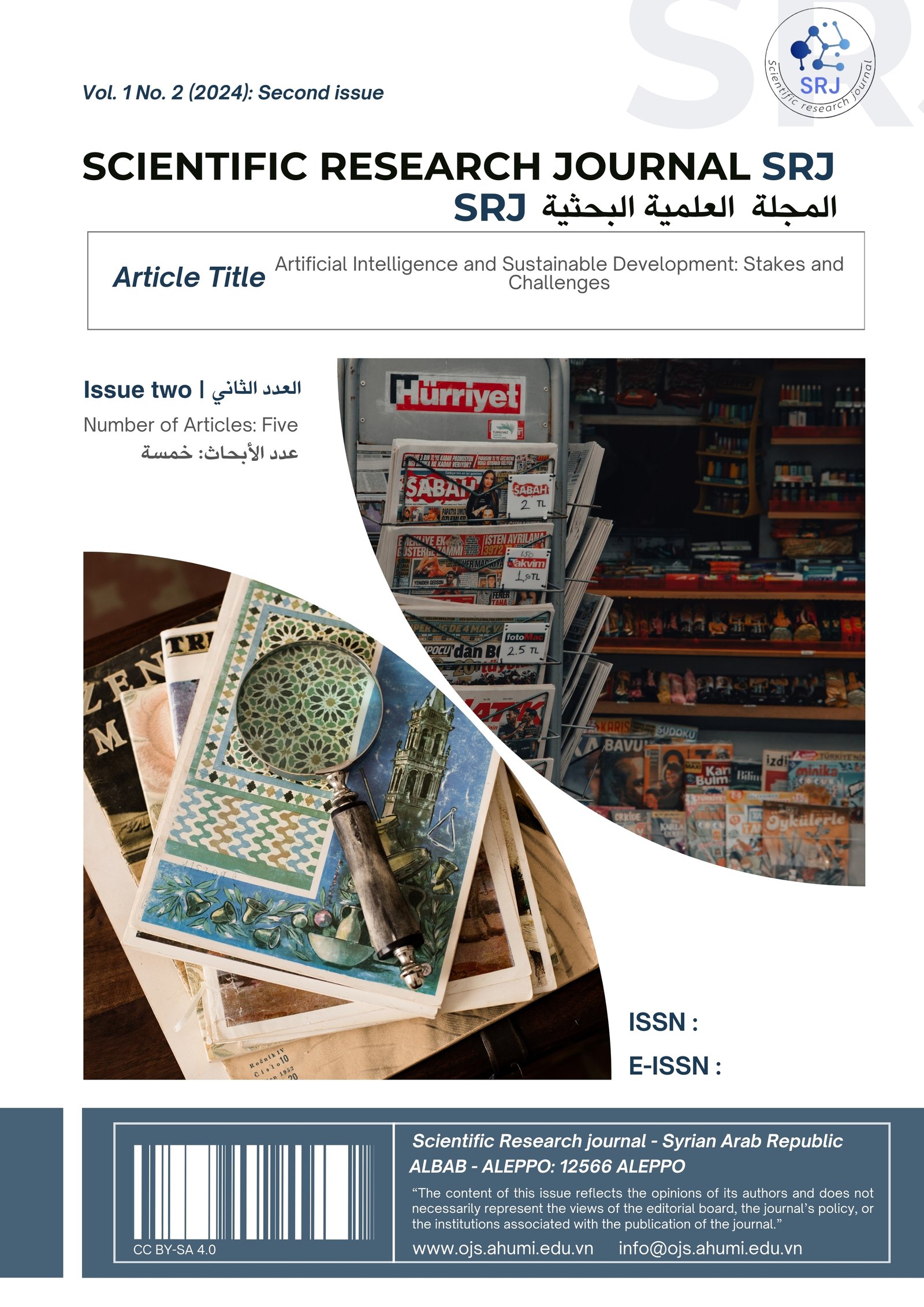
second issue
Vol. 1 No. 2 (2024)The scientific research journal continues its academic journey with a solid intellectual vision, issuing its second volume with a focus on monitoring current developments in various fields. The journal aims to contribute to enriching academic discussions and guiding research towards linking it with economic, social, environmental, and technological issues. Therefore, this volume contains valuable research and studies that, in general, strive to apply digital frameworks to both theoretical and practical contexts.
In this regard, the lead paper, written by Dr. Ali Boulaalam and titled "The Smart University and the Knowledge Society," addresses the challenges of the knowledge society in relation to the university within the context of digital transformation. It tracks the changes necessary for establishing a new scientific system based on a new "organon" (methodology), with a key focus on innovative knowledge engineering. This involves embedding smart systems into the infrastructure of university institutions and establishing a cooperative e-learning system that integrates human and artificial intelligence.
In an effort to advance the field of Arabic language testing, Dr. Nisrine El Hannach presented a comprehensive approach in her article titled "Tests and Linguistic Platforms: The Irfan Proficiency Test as a Model." The article highlights the mechanisms of using digital platforms to create effective language tests capable of evaluating learners' proficiency in their first or second language. This is done by assessing the learner’s actual level in the four language skills: listening, reading, speaking, and writing. The study relies on the Nooj platform, a language platform equipped with the necessary technologies to describe the Arabic language and make it suitable for digital testing.
Regarding the use of artificial intelligence (AI) tools in Islamic research, researchers Meryam El Morabit, Miloud Kouass explored the mechanisms of assessing the reality of AI tools (ChatGPT, Gemini, Quillbot, Qalam) in this field. They identified the opportunities and challenges these tools present and offered recommendations to enhance their usage. The study adopted a descriptive-analytical methodology, gathering data through a survey of 40 PhD students in Islamic studies at Mohammed I University in Oujda. The results revealed a significant gap in awareness about the importance and potential of AI tools in Islamic research, with a large portion of the sample refraining from using these tools in their research despite the opportunities they provide.
On the topic of Information and Communication Technology (ICT), Dr. Asmaa Al-Alaoui presented a research paper on the overwhelming revolution affecting all aspects of life economic, social, and even cultural. She emphasized that ICT has become a driving force behind all technological progress. One of the most impacted fields is higher education, where the digital knowledge era has posed major challenges to the sector, pushing it beyond traditional education methods to what is now known as digital or online education. This shift, especially during times of crises and pandemics (such as COVID-19), has revealed the failure of traditional education to keep pace with the prevailing electronic environment.
In a similar vein, researcher Ahmed Qobbi’s study, titled "Automatic Processing of Arabic: A Study of Automatic Speech Recognition Systems," shed light on the numerous challenges faced in the automatic processing of natural languages, particularly Arabic. Natural language processing (NLP) aims to analyze and process texts at the phonetic, morphological, and syntactic levels using AI. The unique nature of the Arabic language further complicates these tasks. The focus was placed on automatic speech recognition, especially for Arabic, as this research falls within the field of AI that seeks to develop machines to mimic human intelligence in understanding, analyzing, and processing language.
In his article titled "The Film 'The Cell'," Youssef Loumim attempted to present the artistic elements of cinema in its entertainment dimensions, as well as its extensions related to elite cinematic production. In doing so, he established an intellectual approach to this promising field by analyzing the film The Cell by Rabie Johari.
In summary, the topics covered in this issue represent a distinctive academic subject that falls within the scope of digital transformation and the various manifestations and dimensions of AI within the broader framework of Arab cultural systems..
Managing Editor: Dr. Ali Bouallam
-

First issue
Vol. 1 No. 1 (2024)There is no doubt that the Scientific Journal of represents a distinguished academic platform, primarily dedicated to tracking and disseminating the latest scientific advancements across various fields of knowledge. With rigorous adherence to scholarly standards, the journal emphasizes precision, innovation, and originality. In doing so, it contributes to shaping a new generation of scientific publications that prioritize a qualitative approach in the selection of academic content.
In line with this mission, this issue presents five carefully selected articles, originating from the proceedings of the international conference titled “Artificial Intelligence and Sustainable Development: Opportunities and Challenges”, held under the auspices of the aforementioned university. The journal takes pride in addressing current and pressing research topics that have captivated the interest of scholars and experts alike. These contributions significantly enhance the discourse surrounding the digital transformation ecosystem and its economic, social, cultural, and ethical impacts.
At the forefront of this issue is an article authored by His Excellency, the President of Ahumi British University, Professor Dr. Mohamad Salman AlShikh Wis, titled “The Least Mentioned Argument and Some of Its Applications in Family and Criminal Law from the Book Nihayat al-Matlab fi Dirayat al-Madhhab by Imam al-Juwayni.” In this insightful study, Professor Wis rigorously examines an important principle in Shafi'i jurisprudence, known as The Least Mentioned Argument, through Imam al-Haramayn’s legal interpretations in the domains of family and criminal law. The analysis employs a methodologically sound approach that blends both critical examination and comparative analysis.
The second contribution, authored by Dr. Saleh Dahesh Ali Al-Banna, Dean of the Deanship of Quality and Academic Accreditation at Ahumi University, is titled “Personal Future Planning.” The research aims to clarify the importance of personal future planning in the life of a Muslim individual and emphasizes Islam's encouragement of planning as a civilizational value. The researcher employed the descriptive method and highlighted the critical role of planning in organizing life’s affairs, overcoming challenges and difficulties through scientific and objective approaches. Planning is identified as a vital tool for addressing future challenges, preparing for them, and avoiding randomness and disorganization. The study concluded with several findings and recommendations, underscoring the importance of personal planning as a key factor in navigating life's complexities and securing success.
In the third article, titled “Harnessing the Concept of Territorial Intelligence in the Context of Current Technological Transformations”, Prof. Dr. Jawad Dabounou, a professor at the Faculty of Science and Technology in Morocco and an expert in digitalization and territorial intelligence, collaborates with researchers Soumeya Hajbi and Madani Maati. The article examines the historical significance of industrial revolutions in shaping scientific advancements that transform structures and mindsets. It highlights how artificial intelligence has introduced a transformative approach to developmental issues through the lens of territorial intelligence, positioning it as a strategic tool for resource optimization and fostering competitive advantage rooted in spatial identity.
The fourth article, co-authored by Dr. Huyam Sami Al-Zaabi from Ahumi British University and Dr. Saad Khalid from Al-Hikma Global University, is titled “The Role of Artificial Intelligence in Developing the Knowledge Economy.” This study delves into the central role of artificial intelligence in shaping the knowledge economy, where information serves as the primary currency of contemporary economies. The authors focus on the importance of innovation, communication technologies, and knowledge acquisition as vital tools for achieving sustainable development.
The final article, “Measuring the Extent of Secondary School Teachers' Use of Generative AI Tools”, by researcher Hassan Idrissi, explores the practical application of generative AI tools within the field of education. The author presents a series of hypotheses regarding the current use of AI tools in secondary education, drawing conclusions from a carefully selected sample of educators through a scientifically structured survey, leading to significant findings with important implications.
In conclusion, the scholarly content featured in this issue is distinguished by its academic rigor and depth. Each contribution is interwoven with knowledge that aligns with the overarching theme of artificial intelligence and its intersections with a variety of scientific disciplines.
Managing Editor
Professor Dr. Ali Boulaalam